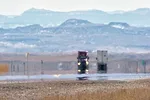
Swiss Trader Had Lucrative Role Getting Iraqi Oil Through Hormuz

Photo: Bloomberg
A little-known Swiss trading company played a key role in the transit through the Strait of Hormuz of an oil supertanker whose stop-start journey captivated the oil market earlier this month, according to people familiar with the matter.
The role of Lytton SA, a Geneva-based trading house with links to Iraq, has not previously been reported. It highlights how the near-closure of the Strait of Hormuz is creating vast money-making opportunities for traders and shipping companies willing to brave the risks of the voyage.
The journey of the Agios Fanourios I taking Iraqi crude to Vietnam became the talk of the global oil industry earlier in May, as traders scour satellite data for signs that shipping through Hormuz might be picking up and offering some respite to the biggest supply disruption in oil market history.
The supertanker, which was holding just under 2 million barrels of crude, was halted first by Iranian and then U.S. authorities. It only passed the American naval blockade just over a week ago after an intervention from Vietnam’s state oil company.
While the oil was destined for PetroVietnam Oil Corp., it was Lytton that assumed responsibility for getting it through Hormuz and its onward journey, the people said.
Lytton and PetroVietnam declined to comment. Eastern Mediterranean Maritime, the manager of the Agios Fanourios I, said in a statement it was unaware of the involvement of any firms except Vietnam’s and Iraq’s state oil companies.
Deep Discount
The reward for getting the cargo out was substantial: Lytton bought the oil at Iraq’s Basrah port at a discount of $18 a barrel to benchmark prices, one of the people said. Based on the premiums being paid for oil outside the Persian Gulf, that implies a gross profit for the trader of approximately $60 million.
The outsized profits on offer are drawing wide-ranging interest — from established players in the oil market to relative newcomers, according to trading and shipping executives. Iraq’s state oil company has been offering cargoes for discounts of as much as $33.40 a barrel this month to anyone willing to buy the oil inside the Gulf and brave exit.
It’s the latest sign of how traders are profiting from the historic disruption to commodity markets caused by the war in Iran. The world’s top oil merchants are enjoying some of their best results on record, Bloomberg has reported, with trading margins as high as $20 to $30 a barrel — or $40 million to $60 million for a supertanker cargo — compared to more normal levels of a few cents.
The biggest trading houses are able to leverage their scale and financial power to grasp opportunities, but the risks of shepherding cargo worth hundreds of millions of dollars through Hormuz are comparatively greater for smaller firms like Lytton.
Based in Geneva, Lytton was set up in 2024 by former Trafigura Group oil trader Hakim Darbouche and Alan Konyar, a onetime executive of Onex DMCC. In Iraq, Lytton is known for an agreement to market oil products from the Taurus refinery in the Kurdistan region. But the firm is also active in the Mediterranean and East Asia trading crude, oil products and naphtha.
Big Costs
Still, while the potential gross profits are huge, not all of the roughly $60 million in gains would have accrued to Lytton: freight rates have skyrocketed since the war began, meaning shipping costs of some $35 million to $40 million for the Agios Fanourios I, one of the people said. High costs of demurrage — the day-rate charged by shipping companies for any delays — also rapidly eat into a trader’s profits, the person said.
Eastern Mediterranean said it couldn’t “confirm the financials” related to the shipment.
The eye-watering freight was one thing. Another is the risk involved in getting a ship through Hormuz.
The Agios Fanourios I set sail through the waterway only after receiving word that the Iranian authorities were willing to allow its passage, which several of the people said was secured directly through the government of Iraq.
As it attempted to sail through the Strait, it was twice told to turn back by Iran, only being allowed to proceed with its journey after frantic diplomatic lobbying from Iraq, they said. On a third attempt, it was ordered to turn in the direction Bandar Abbas in Iran, one of the people said.
The vessel didn’t go to the Iranian port and was never boarded, Eastern Mediterranean said.
When it finally exited the Strait on the night of May 10, it seemed that the transit had been successful, only for the U.S. naval blockade to order the ship to stop in its tracks. The Americans were suspicious that the tanker may have loaded Iranian crude, one of the people said.
Eastern Mediterranean said it wasn’t told why the ship was stopped by the Americans and has long been clear that it didn’t load Iranian oil.
PetroVietnam Oil wrote to the U.S. Naval Forces Central Command urging it to release the tanker, describing it as being “of extreme importance” to the people of Vietnam. After a five-day wait during which the Navy screened the vessel, the U.S. finally allowed it to continue its journey.
Whether the feat is a model for other oil tankers remains to be seen. An uptick in shipping through Hormuz in the past week indicates that some other shipowners and traders are willing to brave the risks involved.
Vitol Group, the world’s largest commodity trader, has been offering Iraqi oil on a ship-to-ship transfer basis outside the Gulf, Bloomberg has reported, suggesting it too may have succeeded in getting barrels through Hormuz.
In addition to the physical risks involved in transit is the risk of sanctions. Iran has been demanding shipowners pay a toll to pass through Hormuz, although it’s not clear how many are doing so. The U.S. Treasury has said paying the toll is a breach of U.S. sanctions and any foreign company doing so risks being sanctioned itself.
A person close to Lytton said the company had not paid any toll to Iran. Eastern Mediterranean also said no toll was paid.
Popular Stories



SupplyChainBrain 2026 ESG Guide: ESG — The Supply Chain’s Biggest Secret
VIEW THE LATEST ISSUECase Studies


Visit Our Sponsors |
|
|
|
|
|
|
|
|
|
|
|
|
|
|
|
|
|
|
|
|
|
|
| |
|
|
|
|
|
|
|
|
|
|
|
|
|
|
|