.webp?height=100&t=1783959879&width=150 "014_how_ai_is_transforming_the_transportation_back_office_v1-(540p).jpg")
Smarter, Faster Decisions: Bekaert Drives Agility with Advanced Scenario Planning
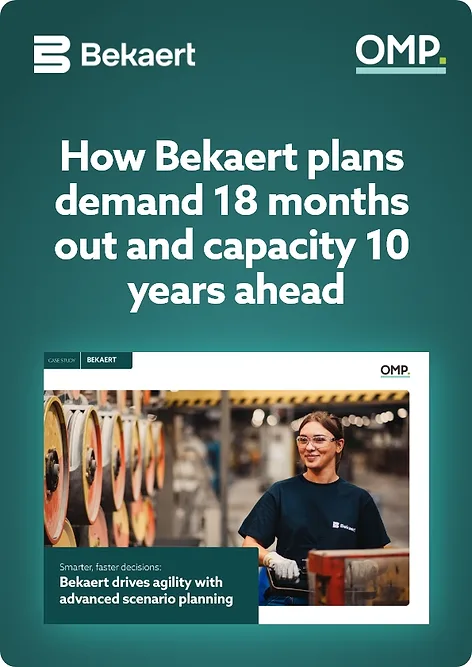
How do you plan for a technology that doesn't exist yet, while keeping today's production lines running? That's the challenge Bekaert faced with its titanium fiber-based porous transport layers, a breakthrough component powering industrial-scale green hydrogen production. As major power players race to lock in their green hydrogen strategies, Bekaert needed to plan years ahead for capacity it hadn't built yet, without losing control of the shop floor today.
The team had built a sophisticated homemade spreadsheet solution to manage monthly tactical cycles and long-term strategic exercises. Until data consistency broke down and S&OP meetings turned into debates about whose numbers were right instead of business priorities.
Bekaert turned to OMP's Unison Planning™ for Metals, already proven across other divisions, and rolled it out for the energy transition business in just six months. Now planners build multiple demand and supply scenarios every month, factoring in production capacity, subcontractor reliance, backlog, inventory positions, and routing priorities, giving full visibility into machine utilization, service levels, and financial impact before decisions are made.
You'll learn how Bekaert:
- Replaced unreliable spreadsheets with reality-based scenario planning for faster, more confident decisions
- Built dual-horizon planning that balances 6-to-18-month demand fulfillment with 5-to-10-year capacity strategy
- Used vertically integrated production and built-in flexibility to scale rapidly when demand shifts
- Reached full S&OP adoption in just six months and is now expanding into demand planning
"Unison Planning has helped us shift from reactive firefighting to proactive, value-driven conversations," says Filip Lanckmans, Global Supply Chain Manager at Bekaert.
Read the case study now and see how Bekaert turned planning complexity into a competitive advantage.

Popular Stories



.webp?height=100&t=1784001702&width=150 "013_what's_really_needed_for_'lights-out'_capability_v1-(540p).png")

SupplyChainBrain 2026 ESG Guide: ESG — The Supply Chain’s Biggest Secret
VIEW THE LATEST ISSUECase Studies


Visit Our Sponsors |