• Advertise
  • Contact Us
  • Supplier Directory
  • SCB YouTube
  • About Us
  • Login
  • Subscribe
  • Logout
  • My Profile
  • LOGISTICS
    • Air Cargo
    • All Logistics
    • Facility Location Planning
    • Freight Forwarding/Customs Brokerage
    • Global Gateways
    • Global Logistics
    • Last Mile Delivery
    • Logistics Outsourcing
    • LTL/Truckload Services
    • Ocean Transportation
    • Parcel & Express
    • Rail & Intermodal
    • Reverse Logistics
    • Service Parts Management
    • Transportation & Distribution
  • TECHNOLOGY
    • All Technology
    • Artificial Intelligence
    • Cloud & On-Demand Systems
    • Data Management (Big Data/IoT/Blockchain)
    • ERP & Enterprise Systems
    • Forecasting & Demand Planning
    • Global Trade Management
    • Inventory Planning/ Optimization
    • Product Lifecycle Management
    • Robotics
    • Sales & Operations Planning
    • SC Finance & Revenue Management
    • SC Planning & Optimization
    • Supply Chain Visibility
    • Transportation Management
  • GENERAL SCM
    • Business Strategy Alignment
    • Customer Relationship Management
    • Education & Professional Development
    • Global Supply Chain Management
    • Global Trade & Economics
    • Green Energy
    • HR & Labor Management
    • Quality & Metrics
    • Regulation & Compliance
    • Sourcing/Procurement/SRM
    • SC Security & Risk Mgmt
    • Supply Chains in Crisis
    • Sustainability & Corporate Social Responsibility
  • WAREHOUSING
    • All Warehouse Services
    • Conveyors & Sortation
    • Lift Trucks & AGVs
    • Order Management & Fulfillment
    • Packaging
    • RFID, Barcode, Mobility & Voice
    • Warehouse Automation
    • Warehouse Management Systems
  • INDUSTRIES
    • Aerospace & Defense
    • Apparel
    • Automotive
    • Chemicals & Energy
    • Consumer Packaged Goods
    • E-Commerce/Omni-Channel
    • Food & Beverage
    • Healthcare
    • High-Tech/Electronics
    • Industrial Manufacturing
    • Pharmaceutical/Biotech
    • Retail
  • THINK TANK
  • WEBINARS
    • On-Demand Webinars
    • Upcoming Webinars
    • Webinar Library
  • PODCASTS
  • WHITEPAPERS
  • VIDEOS
Home » Blogs » Think Tank » Can Smaller Grocers Survive the E-Commerce Game?

Think Tank
Think Tank RSS FeedRSS

Can Smaller Grocers Survive the E-Commerce Game?

Grocery Supply Chain
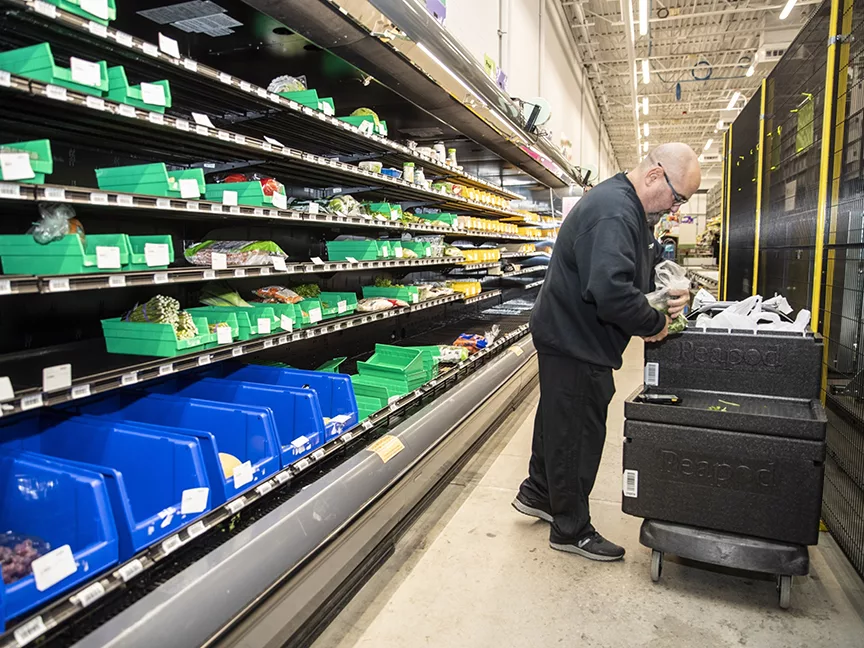
A worker places groceries from an online order into a Peapod delivery bin at a Stop & Shop supermarket. Photo: Bloomberg.
January 11, 2021
Robert J. Bowman, SupplyChainBrain

Even as e-commerce captured a progressively larger slice of retail sales over the years, many consumers continued to do their grocery shopping in physical stores. Attempts in the early dotcom era to sell food and other grocery items over the internet, by ambitious startups like Webvan and Peapod, sputtered. But with the coming of COVID-19, everything has changed.

With communities in lockdown for much of this year, even tech-averse consumers have discovered the convenience of getting their groceries delivered to the door, or at least ready for pickup in the store’s parking lot. U.S. online grocery sales were estimated to grow by nearly 53% in 2020, reaching $89.2 billion, an increase of nearly $30.9 billion over the year before. By 2023, the number is expected to exceed $129 billion, accounting for nearly 10% of total grocery sales.

Along with this shift in buying habits has come a new set of marketing challenges for online grocery sellers. To hang on to their newfound customers once the coronavirus subsides, they’ll need to improve the online customer experience, and find creative ways to appeal to fickle shoppers.

As with traditional retailing, the biggest players will dominate. Big-box giants such as Walmart and Target are poised to extend their dominance in brick and mortar to cyberspace, notwithstanding the challenge posted by e-tailing behemoth Amazon.com. For the small to medium-sized grocer, there’s little air left to breathe.

So how can that smaller animal survive in the e-commerce stampede? According to marketing strategist Matt Voda, chief executive officer of OptiMine, the spoils will go to those companies that make the necessary investments in technology. But doesn’t that put smaller online grocers out of the running?

Not necessarily, says Voda. Major online marketing channels create a “halo effect” that benefits sellers large and small. Paid social media campaigns can have a significant impact on sales both online and in physical stores. And, at a time when personal devices are becoming indispensable shopping tools, grocery brands can drive greater mobile engagement through promotions and conversion of in-store sales. “How a grocery brand chooses to engage with the end consumer really matters,” Voda says.

There’s one area in which the smaller grocer already has an advantage over its bigger competition: familiarity. Voda believes it can extend the concept of the neighborhood store to online sales. By their very nature, big-box retailers can’t always afford to tailor their offerings to the tastes of a local population. “There are merchandise options that larger players find less interesting,” he says.

Smaller grocers can also take advantage of the meal-kit delivery wave. Numerous players are currently jockeying for dominance in that space, some backed by big corporations (as in the case of Nestlé’s recent acquisition of Freshly). But Voda believes there’s room for smaller grocery brands, especially those that can fulfill orders from an existing network of physical stores. “They can put together pre-made meals,” he says. “Big players can’t do that at scale.”

In the end, is the surge in e-commerce good or bad for the smaller grocer? “It’s a headwind for one that doesn’t have a sophisticated e-commerce presence,” says Voda. “That’s hard to put together overnight.” If they haven’t already, smaller entities need to start building that capability now, on the assumption that the shift favoring online sales is a permanent one. “It’s here to stay,” he says, “and investments have to follow that.”

Yet another traditional retailing tool that can be extended to online sales, especially when it comes to the concept of the neighborhood grocer, is the loyalty program. The technology required to support it is becoming more affordable, Voda notes. What’s more, “a lot of grocery shopping behavior is habitual and repetitive. Loyalty programs make a lot of sense in shopper activation and retention.”

For smaller grocery brands, the last piece of the puzzle — delivery to the customer — might be the biggest challenge to surmount. Voda recommends that stores test their capability with the help of a third-party delivery service such as Instacart. Longer term, though, such an entity might prove to be a liability, given that it demands such a large slice of the revenue from every transaction. For a business like grocery, surviving on perilously thin margins in the best of times, that “partner” could spell failure in the long run. “At some point, it might make sense for the grocer to build out its own delivery capability,” Voda says.

Voda doesn’t downplay the marketing and sales challenges that smaller grocers face in the cutthroat world of e-commerce. But he nevertheless believes that those with the right strategy and targeted investments will survive.

“There will be a shakeout,” he says. “The survivors will be more agile, innovative and do a better job of listening to their customers. And they’ll adapt, just like they always have.”


Last Mile Delivery E-Commerce/Omni-Channel Food & Beverage Retail

RELATED CONTENT

RELATED VIDEOS

Subscribe to our Daily Newsletter!

Timely, incisive articles delivered directly to your inbox.

Featured Product

Popular Stories

  • On Demand - Webinar Descartes Tue Jun 23 2026 11a ET.png

    Descartes AI Exchange: AI Agents for Fleet Performance Management

    General SCM
  • A UNIFORMED OFFICER STANDS NEAR A HIGHWAY WITH TRUCKS ON IT

    U.S. Customs Ramps Up AI Investment in Push to Sharpen Enforcement

    Artificial Intelligence
  • On Demand Webinar - Arkieva - Wed Jun 24 2026 2p ET.png

    Shift Left Planning: Why Many Plans Fail to Execute—and How to Fix It

    Webinars
  • A MAP OF THE STRAIT OF HORMUZ SHOWING DOZENS OF BLUE DOTS DISTRIBUTED THROUGHOUT THE WATERWAY

    Traffic Flows Through Hormuz Despite Shock Ship Attack

    Global Gateways
  • Satellite view of the Strait of Hormuz with white graphic lines representing global shipping lanes and maritime traffic between the Persian Gulf and Gulf of Oman.

    Hormuz Highlights How Maritime Risk Assessment Needs to Change

    Global Gateways

Digital Edition

2026 esg cover main scb q2 2026 cover

SupplyChainBrain 2026 ESG Guide: ESG — The Supply Chain’s Biggest Secret

VIEW THE LATEST ISSUE

Case Studies

  • Recycled Tagging Fasteners: Small Changes Make a Big Impact

  • A GRAPHIC SHOWING MULTIPLE FORMS OF SHIPPING, WITH A HUMAN STANDING AT THE CENTER, TOUCHING A SYMBOLIC MAP OF THE WORLD

    Enhancing High-Value Electronics Shipment Security with Tive's Real-Time Tracking

  • A GRAPHIC OF INTERLACING HONEYCOMBED ELEMENTS REPRESENTING GLOBAL BUSINESS TRANSACTIONS

    Moving Robots Site-to-Site

  • JLL Finds Perfect Warehouse Location, Leading to $15M Grant for Startup

  • Robots Speed Fulfillment to Help Apparel Company Scale for Growth

Visit Our Sponsors

4flow Arkieva Blue Yonder
Carton Cloud CoEnterprise Dassault
Duravant E2Open General Logistics Systems
Hy-Tek iGPS Korber
Lyngsoe Procurability Quinyx
SAP Sikick Systech
S&P Global Mobility TADA TransImpact
US Bank Werner Enterprises WSI
  • More From SCB
    • Featured Content
    • Video Library
    • Think Tank Blog
    • SupplyChainBrain Podcast
    • Whitepapers
    • On-Demand Webinars
    • Upcoming Webinars
  • Digital Offerings
    • Digital Issue
    • Subscribe
    • Manage Email Preferences
    • Newsletters
  • Resources
    • Events Calendar
    • 2026 Event Coverage
    • SCB's Great Supply Chain Partners
    • Supplier Directory
    • Case Study Showcase
    • Supply Chain Innovation Awards
    • 100 Great Partners Form
  • SCB Corporate
    • Advertise on SCB.COM
    • About Us
    • Privacy Policy
    • Contact Us
    • Data Sharing Opt-Out

All content copyright ©2026 Keller International Publishing Corp All rights reserved. No reproduction, transmission or display is permitted without the written permissions of Keller International Publishing Corp

Design, CMS, Hosting & Web Development :: ePublishing