RSS
RSS

After years of talk and small-scale pilots, 3D printing is finally poised for widespread use.
In 2020, 3D printing was a $13.7 billion market and forecasted to more than triple, to $43.5 billion, by 2026 (Figure 1).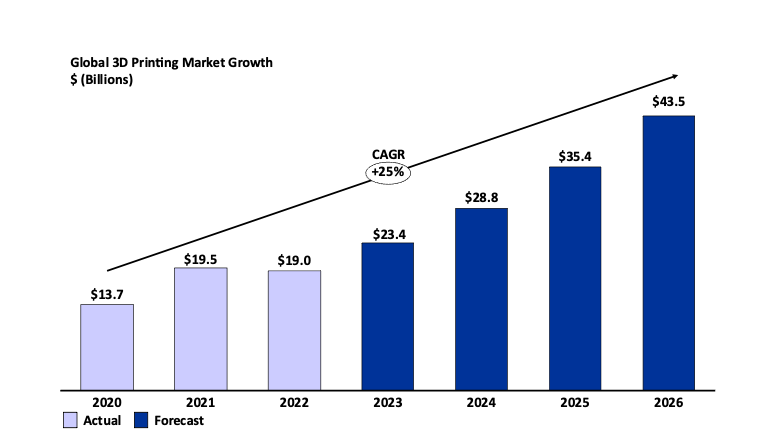 Figure 1: Expected global 3D printing market growth (in $ billions)
Factors in this growth are advances in both hardware and software. In hardware, printing equipment is getting faster, and capable of 3D printing across multiple materials, including plastics and metals. In software, companies are turning to artificial intelligence, allowing product designers and engineers to enhance part durability, functionality and geometry. 3D printing not only enables intricate designs, but also tighter tolerances, enhanced customization, improved strength, and lighter weight. It reduces time to market and alleviates warehousing costs and risk. As companies acquire the ability to print “on demand,” they expand their use of more agile manufacturing approaches, and alleviate the need to carry excess parts.
3D printing has an advantage over traditional manufacturing in that there are no tools to move or build. With the replication or transfer of digital files, a manufacturer can move or grow production across regions, bolstering the “buy-where-you-build,” or just-in-time, supply chain strategy.
Companies in any industry can benefit from 3D printing when taking an end-to-end approach to implementation. Such an approach encompasses three steps: select, build and scale.
Select
Prototyping is a gateway to building something bigger. As a company adapts 3D printing capabilities, boundaries and gains competency, the world expands beyond engineering and design to operations. The engineering and operations teams, focusing efforts on new product innovation, current production, prototype, post-production and associated tooling, can identify a prioritized set of parts for trial. Activities in the select step include:
Defining potential parts to be 3D printed, then mapping those parts to company revenue. Map the value of a part to the products in which they’re utilized in the bill of materials. The sum of all annual shipment values for all products is the total revenue “dependent” on a part. Repeat this process of each part, and plot the values on a logarithmic scale.
Focusing on the highest revenue-dependency parts. Score the parts based on a weighted average criterion. A simplistic approach is to apply a low to high (1-5) scale for each characteristic. Weightings can change based on experience.
Plotting the parts on a 3x3 matrix to determine the critical parts. The x-axis is defined by the part applicability score in the prior step and a subjective y-axis business impact score defined by low, medium or high.
Build
Once the critical parts are identified, the organization must determine the best method to procure the parts, which will entail a thorough assessment of in-house and supplier capabilities. Steps include:
Determining the best way to procure the parts. Independently conduct a series of Make vs. Buy analyses to segment the parts. Five unique, comprehensive analyses should be conducted to ensure completeness:
- 3D make versus 3D buy,
- 3D make versus traditional manufacturing make,
- 3D make versus traditional manufacturing buy,
- 3D buy versus traditional manufacturing buy, and
- 3D buy versus traditional manufacturing make.
Creating an action plan. Based on the outcome of the make-versus-buy analyses, define how your organization should best procure the parts.
To execute the action plan, an organization must assess and develop both in-house capabilities and third-party suppliers. Manufacturing engineering, at both the corporate and plant levels, must be aligned to determine the required equipment specifications and how they will fit with existing work cells. Suppliers, meanwhile, usually have dedicated expertise with different material types and 3D printing processes, and some may have capabilities with both.
Scale
As in-house capabilities grow, and third-party suppliers identified and used, the final step is to create an internal center of excellence. A CoE must be self-sustaining with engineering and operational competencies, blueprint and specification design, digital storage, and supplier development and relationship management. Factors that could affect a company’s ability to scale 3D printing include:
Materials. The variety of raw materials for 3D printing is on par with traditional manufacturing, though it’s usually more expensive due to the additional processing. Equipment. Printing speed remains a problem in manufacturing products quickly. This restricts the range of industries and applications, making it difficult to effectively integrate into high-volume manufacturing cells, and relegating 3D printing to high-profit and low-volume intricately designed products.
Supplier capabilities. As a maturing industry, fewer sources exist, and these suppliers need to be carefully vetted and developed for consistent quality.
3D printing is on the verge of industrialization. Product manufacturers can gain a competitive advantage using this technology to identify, build and scale 3D printing capabilities by implementing a CoE focused on the product lifecycle. Faster printers, integrated software, qualified materials and additional suppliers continue to make this a realistic solution for many applications. As the technical barriers continue to fall, manufacturers must improve their utilization of this technology, building their internal skills, industrialized processes, and business models to take full advantage of a technology that’s finally ready to go live.
Adam Robbins is a principal director, and Paul Barnaba is a senior principal, in the Strategy Operations Practice of Accenture.