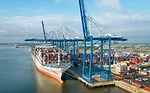
End of Suez Snarl Marks Beginning of New Stress on Global Trade

Removed from the Suez Canal’s main channel, the Ever Given leaves in its wake several weeks or months of disruptions across a world economy where the pandemic revealed both the sturdy backbone of global trade and an Achilles’ heel.
“It’s not a cork-out-of-a-bottle moment,” said Peter Aylott, director of policy at the U.K. Chamber of Shipping. “We could still be days away from the canal being completely free.”
The reopening kicks off a new wave of stress on supply chains — the intertwined network of ships, ports, trucks, trains and warehouses that shuttle products from a factory on one side of the planet to a retail shelf or production line on the other. A surge in e-commerce means even greater consumer demand for speed, putting added strain on transportation and boosting freight rates to record highs.
Even a temporary clog in a major artery like the Suez is problematic because the world’s nearly 6,000 container ships run on schedules, with a finite number of steel boxes to go around. They can’t be repositioned to where demand pops up or quickly shifted away from regions where economic activity is slow. Capacity can be tweaked by adjusting the speed of vessels but also with a blunter tool: canceling sailings that aren’t possible anymore or aren’t economically viable. The Suez incident may unleash plenty of those.
That leaves the owners of cargo — and all the logistics industries handling imports and exports — at the mercy of the container carriers.
Toppling Dominoes
“The metaphorical dominoes have already been toppled,” said Lars Jensen of SeaIntelligence Consulting. “We will continue to see the unfolding of congestion issues in Europe as the cargo arrives, blank sailings resulting from the severe delay of many vessels, as well as a deterioration of the equipment situation.”
In the near term, ports from Europe to Asia are bracing to be inundated with goods held up near Egypt for almost a week.
The Port of Rotterdam, Europe’s largest seaport, late last week counted 59 container ships ensnared in the Suez congestion that were headed its way, though it wasn’t possible to estimate when they’d arrive. In Spain, ports in Algeciras, Barcelona and Valencia were reviewing revisions to arrival schedules and preparing contingency plans for more working hours to handle the unpredictable flow of ships.
The disruption spreads well beyond container shipping: scores of oil, gasoline, natural gas and other tankers and vessels were halted by the blockage, stunting normal supply and delivery routines across the energy and chemical sectors. Before the Ever Given ran aground, about 2 million barrels of crude and petroleum products transited the canal every 24 hours.
Strained Ports
In the near term, the traffic jam may hamper efforts by European gas buyers to restock inventories eroded by winter demand. That may present U.S. gas exporters with an opportunity to grab market share, said Andy Weissman, chief executive of EBW Analytics.
Freight rates for bulk ships used to haul grains and metal may also remain elevated. The Baltic Dry index recently hit an 18-month high amid strong Chinese corn and soybean buying, and growing metal demand.
Meanwhile, a Chinese logistics executive warned that the impact on global trade could linger as backlogs in Europe worsen.
One 747
Ports are already struggling to handle normal shipping volumes because of the pandemic, and now they’ll need to cope with many delayed vessels all arriving at once or in quick succession, said Max Wei, general manager of international business at Speedaf Logistics Ltd.
Under the best-case scenario, it will take a month of more to work through the congestion, he said.
With ocean freight maxed out, importers are looking for other modes even if they are more expensive.
Vivian Lau, a Hong Kong-based logistics executive, said the surge in demand for air freight is set to continue even after the Suez logjam clears. Online shopping and the scarcity of available containers are among reasons why sellers and buyers will continue to scramble.
“Over the weekend I was up trying to find a few 747s,” said Lau, vice chair and group chief executive officer of Pacific Air Holdings. “I was able to find one, I wasn’t able to find a few.”
In a sign of that demand, Abu Dhabi’s Etihad Airways will temporarily convert a fifth Boeing Co. 777-300ER jetliner to cargo duty.
While the squeeze on air freight was already happening without the Suez blockage, Lau sees another legacy from the past week’s events: more debate on reshaping supply lines.
“You can’t just sit in one part of the world assuming that things are going to be running like clockwork and you don’t need to keep any inventory because they will arrive ‘just in time’,” she said. “The Suez Canal blockage is just another reminder.”
Rail Alternative
Sigrid Nikutta, a DB Cargo management board member, said rail offers another option when barriers arise.
“During Covid, we have seen that trains can go through borders where roads were closed and we see this at the moment, when the seaway is closed trains can go on,” she said Monday in an interview with Bloomberg Television.
The Suez-related turmoil may ripple beyond Europe and Asia.
Charlotte, North Carolina-based Premier Inc. helps more than 4,000 hospitals manage purchasing and supplies. Last year, huge increases in demand caused shortages for items like gloves, gowns and masks. While crisis-level shortages have abated, it left U.S. hospitals and suppliers with less inventory on hand and more sensitive to fresh hiccups in the supply chain.
“For many, many, many products, there is no safety stock in the channel,” said David Hargraves, Premier’s senior vice president of supply chain.
The Suez backlogs are just the latest in a series of cascading events that will delay a key input to plastic medical gear: resins. The company has warned member hospitals to prepare for “a higher number of shorter duration or sporadic shortages,” Hargraves said.
Popular Stories




SupplyChainBrain 2026 ESG Guide: ESG — The Supply Chain’s Biggest Secret
VIEW THE LATEST ISSUECase Studies


Visit Our Sponsors |
|
|
|
|
|
|
|
|
|
|
|
|
|
|
|
|
|
|
|
|
|
|
|
|
|
|
|
|
|
|
|
|
|
|
|
|
|
|