
SCB FEATURE
Let’s Face It: Last-Mile Delivery Fails the Sustainability Test
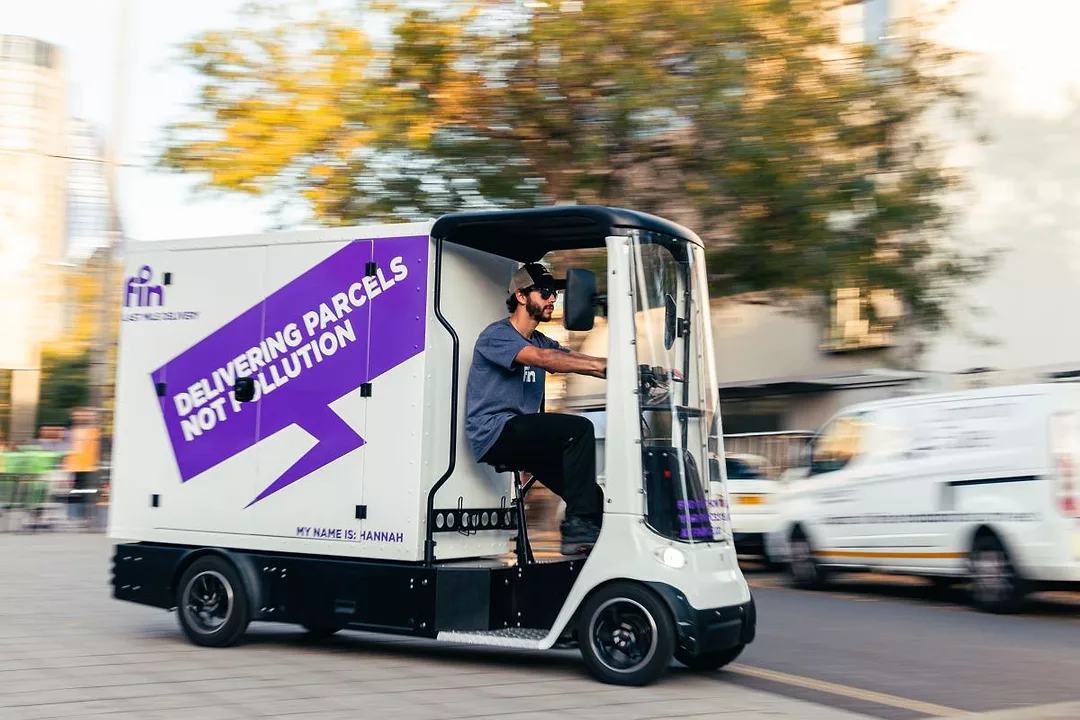
Fin’s e-assisted bikes can carry a cargo of 550lbs, and the external structure protects the rider both from rain and other vehicles. Photo: Fin Sustainable Logistics.
Why is it so hard for last-mile delivery companies to understand that their fundamental business model earns them a resounding raspberry when it comes to “green” operational practices?
Here are some statistics, just for the city of London. Delivery vans account for 19% of total miles driven by any vehicle and 30% of the city’s transport-related CO2. They’re involved in 40% of bicycle crashes and 19% of deaths from pedestrians being struck by vehicles. There’s no measure of how much of the city’s notorious congestion they account for, but any resident of The Big Smoke will tell you: it’s significant.
“And they’re half full, just transporting air!” laments Rich Pleeth, chief executive officer of Fin Sustainable Logistics.
Fin’s mission is to offer an alternative to the major players in the $130 billion last-mile delivery business, which it says is “riddled with greenwashers who tout environmental practices without providing tangible examples or solutions.” The idea is to implement a sustainable last-mile logistics solution that includes cargo bikes and electric vehicles. London-based Fin was launched in 2022, and uses a fleet of all-electric cargo bikes and vans to deliver tens of thousands of packages a day for customers like HelloFresh and Ikea.
It’s not hard to see the existing problem. Anyone with a daytime street view in an urban or suburban area will be familiar with the sight of multiple last-mile delivery vehicles — including those belonging to postal services, UPS, FedEx, DHL and Amazon — making the rounds many times a day, usually delivering individual packages. The self-evident questions are: Can’t you consolidate all these packages going to the same address or block or street on the same day? Do you really need a giant van to deliver a small box? Efforts to address the first question are rare, and tend to rely on unusual abilities to compel delivery companies to consolidate, such as the Arup Regent Street delivery and servicing reduction scheme in the center of London. Pleeth’s mission is to focus on the second one.
“If you order yourself an iPhone or a new sweater, the most likely thing is it’s going to turn up in a van with a big powerful engine," says Pleeth. "We’re not against vans; we’re multimodal. What we’re against is using them when they’re not needed. Vans make lots of pollution and kill a lot of people.”
Pleeth’s argument is that final-mile delivery as it stands is super-inefficient in urban centers, where cargo bikes are far better suited to the task. In fact, he says, Fin’s research shows that 91% of all business-to-consumer deliveries in the Greater London area of 7 million people could be made by cargo bike or electric car. “Vans are brilliant for longhaul trips and to deliver rural parcels. What we see is that in urban centers we can use an electric car or bike to make a delivery carbon net-zero, and more efficiently than vans, so we don’t contribute to congestion.”
Read More: How to Fix Freight? Stop the Waste.
Fin’s e-assisted bikes can carry a cargo of 250kg (550 pounds), and have an external structure that protects the rider both from rain and other vehicles. Deliveries in the denser urban areas are almost always made by bike, with electric vans being used further out. A route optimizer minimizes miles driven.
A number of European and U.S. delivery company startups are racing to serve the growing market for zero-emission last-mile deliveries in cities before giant shippers do the same, according to Reuters.
Pleeth points out that there’s also a growing legislative movement in Europe against inefficient deliveries that cause pollution and congestion. London has its Ultra Low Emission Zone. In France, most heavy goods vehicles over 7.5 metric tons are banned from the road and motorway network every weekend and on public holidays, with exceptions for trucks carrying perishable produce or refrigerated produce, those servicing sporting events or trade fairs, and a few other cases. Further, trucks are restricted on Monday and Friday mornings within the inner ring road of Paris.
In Spain, the City of Barcelona announced in February, 2023 that it will be implementing a yearly tax on transport companies specializing in home deliveries. The tax will apply to all delivery companies with a turnover of over €1 million ($1.09 million) annually and pay an income tax of 1.24%. It is hoped the initiative will also nudge people toward utilizing delivery depots and hubs instead of getting deliveries delivered to their door.
Read More: Consumers Want Greener Delivery Options — But Retailers Have to Explain Them
Additionally, as of January 5, 2023, the European Union Corporate Social Reporting Directive requires companies with more than $3 million in revenues to publish regular reports on the social and environmental risks they face, and on how their activities impact people and the environment. This will include major delivery companies.
Right now, Fin is focused on London. But, backed by MaC Venture Capital, the company is expanding, and hopes to bring more companies under the Fin umbrella. It’s also looking for investment from conventional last-mile players such as DHL and Amazon, Pleeth says. Fin recently announced its purchase of Sweden-based Urb-it. The acquisition’s technology integrates with e-commerce giants such as Cainiao, AliExpress, THG, Zara, Metapack and Shein, and Fin says it will open doors to a wide range of partnerships, resulting in quicker, greener deliveries across the U.K.
Pleeth says it’s a mistake to think that consumers will pay more for greener delivery services, and that that approach is in any case barking up the wrong tree. Saving resources means that higher equipment costs, such as for EVs, are counter-balanced. “We can’t say, because you want to be green it’s going to be more expensive," says Pleeth. "It has to be that we’re using a more efficient vehicle and a more efficient route, so it’s going to be the same cost. That’s very important."
“We have to run a business that can be green on top but has a black bottom line,” Pleeth says.
Popular Stories




100 Great Supply Chain Partners 2026: The Secret to Supply Chain Success
VIEW THE LATEST ISSUECase Studies


Visit Our Sponsors |
|
|
|
|
|
|
|
|
|
|
|
|
|
|
|
|
|
|
|
|
|
|
|
|
|
|
|
|
|
|
|
|
|
|
|
|
|
|
|
|
|
|
|
|
|
|
|
|
|
|
|