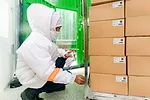
Movement across borders is as simple as getting in a car or on a plane. It's a seamless, simple experience to which most people devote little thought. For both merchants and consumers, however, the path to online and offline purchasing across borders is still a bumpy one.
Import cargo volume at the nation's major retail container ports is expected to slow down this month following record levels seen in September and October as retailers rushed to bring merchandise into the country ahead of a possible shutdown of West Coast ports, according to the monthly Global Port Tracker report released by the National Retail Federation and Hackett Associates.
Replenish Bottling LLC has launched a sustainable product line that has the potential to change how many water-based consumer products are designed, manufactured and sold. The packaging technology can be found in a new line of concentrate household cleaning and personal care items sold under the CleanPath brand.
Those watching the 3D printing category can now look beyond office supply retailers. Target is now offering 3D printing for small decorative and gift items for the holidays.
Shrink, comprised of shoplifting, employee or supplier fraud and administrative errors, cost the global retail industry more than $128bn last year, $42bn in the US alone, according to the latest Global Retail Theft Barometer. This represents 1.29 percent of retail sales, on average.
By 2019, retail sales from all channels are expected to hit $19.6tr, according to market research company Euromonitor International, and beginning five years from now as much as a third of new retail sales will come from China.
Four years ago, when its little card reader attachments for phones and tablets began to show up in cabs and at farmers' markets, Square was one of the coolest, most innovative companies in Silicon Valley. That's over.
Research reveals vast age differences in U.S. consumers' attitudes toward mobile payments, with Generations Y and Z - often referred to as Millennials - twice as likely to view them as faster, easier or more efficient than other types of transactions. These younger consumers also show more confidence in the security of mobile payments - although Generations Y and X are actually more concerned than Baby Boomers about the possibility of a personal information breach via mobile payments.
A majority of U.S. shoppers, 60 percent, said they would be comfortable giving out personal information, anonymously, to their favorite stores in exchange for benefits and rewards. Another 56 percent would give out the same information to a product brand and 46 percent to a product app, according to a recent survey from Wearables.com and The Center for Generational Kinetics.
The robots are coming. Lowe's is testing whether new "bots on wheels" can improve its customer service, like helping a shopper find a match for something as simple as a nail. Four robots are being tested an Orchard Supply Hardware store owned by Lowe's Companies Inc. in San Jose, Calif.