
• Advertise
  • Contact Us
  • Supplier Directory
  • SCB YouTube
  • About Us
  • Login
  • Subscribe
  • Logout
  • My Profile
  • LOGISTICS
    • Air Cargo
    • All Logistics
    • Facility Location Planning
    • Freight Forwarding/Customs Brokerage
    • Global Gateways
    • Global Logistics
    • Last Mile Delivery
    • Logistics Outsourcing
    • LTL/Truckload Services
    • Ocean Transportation
    • Parcel & Express
    • Rail & Intermodal
    • Reverse Logistics
    • Service Parts Management
    • Transportation & Distribution
  • TECHNOLOGY
    • All Technology
    • Artificial Intelligence
    • Cloud & On-Demand Systems
    • Data Management (Big Data/IoT/Blockchain)
    • ERP & Enterprise Systems
    • Forecasting & Demand Planning
    • Global Trade Management
    • Inventory Planning/ Optimization
    • Product Lifecycle Management
    • Robotics
    • Sales & Operations Planning
    • SC Finance & Revenue Management
    • SC Planning & Optimization
    • Supply Chain Visibility
    • Transportation Management
  • GENERAL SCM
    • Business Strategy Alignment
    • Customer Relationship Management
    • Education & Professional Development
    • Global Supply Chain Management
    • Global Trade & Economics
    • Green Energy
    • HR & Labor Management
    • Quality & Metrics
    • Regulation & Compliance
    • Sourcing/Procurement/SRM
    • SC Security & Risk Mgmt
    • Supply Chains in Crisis
    • Sustainability & Corporate Social Responsibility
  • WAREHOUSING
    • All Warehouse Services
    • Conveyors & Sortation
    • Lift Trucks & AGVs
    • Order Management & Fulfillment
    • Packaging
    • RFID, Barcode, Mobility & Voice
    • Warehouse Automation
    • Warehouse Management Systems
  • INDUSTRIES
    • Aerospace & Defense
    • Apparel
    • Automotive
    • Chemicals & Energy
    • Consumer Packaged Goods
    • E-Commerce/Omni-Channel
    • Food & Beverage
    • Healthcare
    • High-Tech/Electronics
    • Industrial Manufacturing
    • Pharmaceutical/Biotech
    • Retail
  • THINK TANK
  • WEBINARS
    • On-Demand Webinars
    • Upcoming Webinars
    • Webinar Library
  • PODCASTS
  • WHITEPAPERS
  • VIDEOS
Home » Blogs » Think Tank » The Game-Changing Role of Graph Technology in Supply Chain

Think Tank
Think Tank RSS FeedRSS

The Game-Changing Role of Graph Technology in Supply Chain

A HIGHLY COMPLEX SYSTEM OF ROADWAYS CROSSING OVER ONE ANOTHER SEEN FROM ABOVE

Photo: iStock.com/AerialPerspective Works

January 30, 2024
Hemanth Holla & Sudarshan NR, SCB Contributors

As they grow ever more complex, modern supply chains require comprehensive lifecycle orchestration.

Among the many challenges they face is integration of upstream and downstream partners. Companies typically use different management systems for multiple functions that fail to “talk” to one another. Hence, the impact of an upstream supply disruption isn’t easily traced to a downstream stockout. What’s needed is a system that enables dynamic visibility.

Traditionally, supply chains have depended on relational database management system (RDBMS) software and structured query language (SQL) to achieve visibility. Yet those traditional tools have failed to keep pace with the increase in complexity. Modern supply chains demand comprehensive oversight, near-real-time insights into relationships and interdependencies, and the ability to predict risks and create effective mitigation strategies. This, in turn, has given rise to the need for intelligent visibility, encompassing both structural and dynamic aspects.

Despite major advances, just 3% of companies have reached autonomous execution, and many still rely on predictive or prescriptive use of data (67% and 40%, respectively). Even with application programming interface (API) integration, the limitations of RDBMS highlight the need for solutions that offer quick insights into today’s non-linear supply chains.

From Structural to Dynamic Visibility

Shifting from structural to dynamic visibility is essential for companies looking to gain a competitive edge in their supply chains, and this is where graph databases come into play. Unlike traditional databases that use tables for data storage, graph databases represent data as nodes and edges, making them ideal for modeling complex networks like supply chains. 

Furthermore, graph databases excel in querying connected data, allowing for quick identification of relationships, including tracing second-tier suppliers for specific product variants. They offer other significant advantages over relational databases, such as improved scalability for large and complex datasets, and flexibility in handling various data types — structured, semi-structured and unstructured. As a result, graph technology, which was initially popular in social networks (such as LinkedIn), is now proving indispensable for navigating the intricacies of modern supply chains.

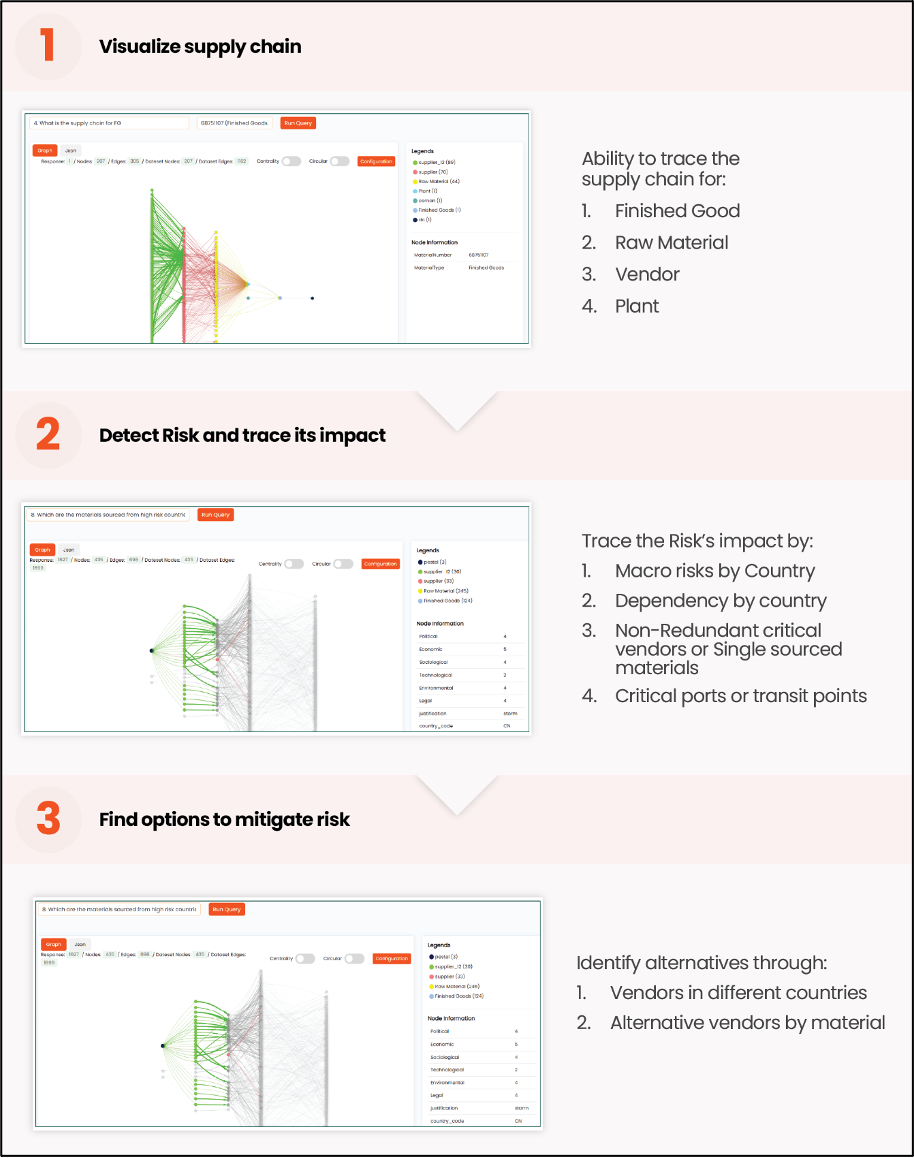
Using data from enterprise resource planning (ERP) systems, quality and compliance documents, export data and more, graphic databases create 360-degree supply chain visualizations. Key capabilities that play a crucial role in understanding the network include:

  • Betweenness centrality. Identifies potential bottlenecks by measuring the frequency at which a node appears on the shortest paths within the network. For example, do your goods flow through a specific port more than others?
  • Degree centrality. Assesses a node’s load and dependency within the network, such as how crucial a warehouse is to a supply network.
  • Regional dependence. Analyzes natural clusters within the network, highlighting areas of high interdependency. For example, are some of your vendors located close to each other?

These metrics help enhance supply chain visibility, enabling supply chain leaders to identify and counter risks and vulnerabilities. For instance, during disruptions such as natural disasters, graph databases can quickly simulate impacts across the supply chain, enabling timely evaluation of alternate scenarios and the implementation of effective mitigation strategies. 
Holla.png

Riding the Wave of Graph Technology

With its growing adoption in various sectors, graph technology is predicted by Gartner to be central to climate change response and fraud detection, with 80% of data and analytics innovations adopting the technology. Major firms are also increasingly turning to graph technology, including hyperscalers and consultancies. Apart from end-to-end supply chain visibility, graph technology helps integrate data across silos. It enables quick simulations and insights for risk mitigation and optimization. And as supply chains expand, their scalability effectively captures complex data. Additionally, it enhances transparency and trust through live visibility, and aids in ethical sourcing monitoring.

The future of supply chain management is intertwined with advances in graph technology. It will help enterprises to analyze, understand and respond to complex data landscapes. Those equipped with a strong graph database tech stack will lead the race to agile and efficient supply chains.

Hemanth Holla is director, supply chain products, and Sudarshan NR is manager, supply chain, with Tredence Inc.


Forecasting & Demand Planning Inventory Planning/ Optimization Supply Chain Planning & Optimization Supply Chain Visibility

RELATED CONTENT

RELATED VIDEOS

Subscribe to our Daily Newsletter!

Timely, incisive articles delivered directly to your inbox.

Featured Product

Popular Stories

  • On Demand - Webinar Descartes Tue Jun 23 2026 11a ET.png

    Descartes AI Exchange: AI Agents for Fleet Performance Management

    General SCM
  • A UNIFORMED OFFICER STANDS NEAR A HIGHWAY WITH TRUCKS ON IT

    U.S. Customs Ramps Up AI Investment in Push to Sharpen Enforcement

    Artificial Intelligence
  • On Demand Webinar - Arkieva - Wed Jun 24 2026 2p ET.png

    Shift Left Planning: Why Many Plans Fail to Execute—and How to Fix It

    Webinars
  • A MAP OF THE STRAIT OF HORMUZ SHOWING DOZENS OF BLUE DOTS DISTRIBUTED THROUGHOUT THE WATERWAY

    Traffic Flows Through Hormuz Despite Shock Ship Attack

    Global Gateways
  • Satellite view of the Strait of Hormuz with white graphic lines representing global shipping lanes and maritime traffic between the Persian Gulf and Gulf of Oman.

    Hormuz Highlights How Maritime Risk Assessment Needs to Change

    Global Gateways

Digital Edition

2026 esg cover main scb q2 2026 cover

SupplyChainBrain 2026 ESG Guide: ESG — The Supply Chain’s Biggest Secret

VIEW THE LATEST ISSUE

Case Studies

  • Recycled Tagging Fasteners: Small Changes Make a Big Impact

  • A GRAPHIC SHOWING MULTIPLE FORMS OF SHIPPING, WITH A HUMAN STANDING AT THE CENTER, TOUCHING A SYMBOLIC MAP OF THE WORLD

    Enhancing High-Value Electronics Shipment Security with Tive's Real-Time Tracking

  • A GRAPHIC OF INTERLACING HONEYCOMBED ELEMENTS REPRESENTING GLOBAL BUSINESS TRANSACTIONS

    Moving Robots Site-to-Site

  • JLL Finds Perfect Warehouse Location, Leading to $15M Grant for Startup

  • Robots Speed Fulfillment to Help Apparel Company Scale for Growth

Visit Our Sponsors

4flow Arkieva Blue Yonder
Carton Cloud CoEnterprise Dassault
Duravant E2Open General Logistics Systems
Hy-Tek iGPS Korber
Lyngsoe Procurability Quinyx
SAP Sikick Systech
S&P Global Mobility TADA TransImpact
US Bank Werner Enterprises WSI
  • More From SCB
    • Featured Content
    • Video Library
    • Think Tank Blog
    • SupplyChainBrain Podcast
    • Whitepapers
    • On-Demand Webinars
    • Upcoming Webinars
  • Digital Offerings
    • Digital Issue
    • Subscribe
    • Manage Email Preferences
    • Newsletters
  • Resources
    • Events Calendar
    • 2026 Event Coverage
    • SCB's Great Supply Chain Partners
    • Supplier Directory
    • Case Study Showcase
    • Supply Chain Innovation Awards
    • 100 Great Partners Form
  • SCB Corporate
    • Advertise on SCB.COM
    • About Us
    • Privacy Policy
    • Contact Us
    • Data Sharing Opt-Out

All content copyright ©2026 Keller International Publishing Corp All rights reserved. No reproduction, transmission or display is permitted without the written permissions of Keller International Publishing Corp

Design, CMS, Hosting & Web Development :: ePublishing