
Blockchain Could Revolutionize the World of Supply Chain Management
I was recently at a Detroit Tigers game with my friend George. I met him in graduate school where it quickly became apparent that he was much smarter than me. Ever since, I have been looking over his shoulder, literally and figuratively, to learn something new. This night in Detroit was no different. George was glued to what appeared to be a stock price chart on his iPhone. “What are you looking at?” I asked. “Have you heard of bitcoin? I bought one and I am looking at its price history.” George then attempted to explain to me what bitcoin is. “It’s a digitally enabled cryptocurrency that gives people the ability to exchange anything of value.” Trying to hide my blank stare of confusion, I replied, “Oh, so how are your wife and kids?” Nevertheless, bitcoin was now on my radar.
After listening to people talk about the topic on NPR and CNBC, the one conclusion I came to is that no one really understands bitcoin or it’s potential. Then I watched an interview with the CEO of a company called Ethereum, who said, “Bitcoin will not be the big game changer to our economy. It is the underlying technology [blockchain] that will really change how commerce is done.” When asked which industry sectors could benefit the most from blockchain, the CEO responded, “supply chain management.” Now I was really paying attention.
What is Blockchain?
Twenty years ago, people had to manually balance their checkbooks. Yes, I’m middle-aged, but stay with me. We recorded debits and credits of money coming in and going out of our checking accounts to calculate our available cash balance. Our checkbooks were our personal financial ledgers. Then there was the advent of online banking through which my wife and I could have a joint checking account. My personal financial ledger, once exclusive to me, had now become a distributed ledger made accessible to two people. We both had the ability to view and manage each other’s financial activity with full transparency and accountability, for better or worse. Blockchain is a joint checking account on anabolic steroids. It is a digital distributed ledger that can be used by multiple business parties to conduct financial transactions, trace product movement, record business activities and/or process legal documentation in a secure and recordable environment.
According to The Economist magazine, the first distributed blockchain was developed by an anonymous person or group referred to as Satoshi Nakamoto in 2008. It was implemented the following year as the underlying technology for the digital currency bitcoin, where it functions as a public ledger for all transactions. The technology has a strange history and somewhat esoteric application, so let’s look at a more practical example to understand how it works.
How Does Blockchain Work?
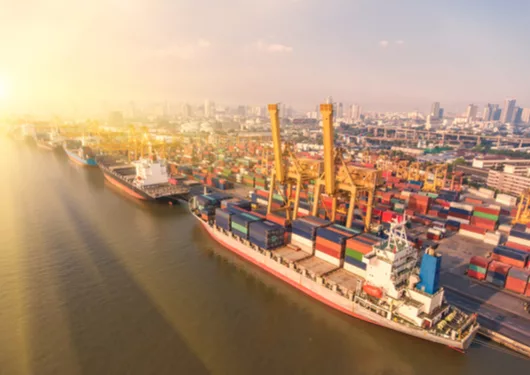
The process for shipping a 40-foot container of sneakers from Shanghai to Seattle is not much different than it was 50 years ago. It is a complex endeavor that involves importers, exporters, freight forwarders, clearing agents, shipping lines, haulage companies, intermodal operators, surveyors, banks and insurance brokers. These stakeholders are collectively responsible for processing roughly 55 documents such as commercial invoices, packing lists, certificates of origin, shipping instructions, bills of lading, cargo inspection certificates, customs clearance documents and freight invoices. The process is manual, paper-based and siloed within each stakeholder organization, resulting in hundreds of communication events for a single container.
Using blockchain technology, the previously mentioned stakeholders can now create their own digital ledger and greatly reduce the amount of time and labor to process container shipments. For example, the sneaker manufacturer, a pre-verified participant or signatory in the digital ledger, uploads the packing list, commercial invoice and certificate of origin. That transaction is encrypted with a unique 60 character alpha-numeric code, effectively fingerprinting the transaction, which is then time-stamped. This is referred to as a “block.” Next, Chinese customs (also a pre-verified participant) provides export approval on the documentation, which is posted as a separate transaction or block, with its own 60-character encryption, then time-stamped and linked to the exporter’s document upload. The blockchain begins to form. Simultaneously, the importer will upload their import license, delivery instructions and necessary clearances activating another block that is encrypted, time-stamped and linked to the other transactions. When the freight forwarder uploads the House Bill of Lading (HBL), marine insurance and cargo inspection certificates, there is full visibility to the other documents already uploaded, the entities that authorized them and when those authorizations took place. Clearing agents, shipping lines, haulers, intermodal operators and surveyors all submit their documentation and approvals through the same process. The end results are 1) a secure, centralized record of trust, which provides end-to-end visibility of the container’s journey 2) demonstrable costs savings through the elimination of manual processing, duplicative communication and organizational delays.
Smart Contracts
The example provided above would involve the use of “smart contracts,” a technology feature enabled by a blockchain. Smart contracts provide an automated escrow environment in which they can be executed without human interaction. However, since they are not widely used, their legal adoption is still in question.
Who is Using Blockchain?
Blockchain is not theoretical. Companies are currently piloting the technology and getting ready for deployment. Forbes recently reported on the best known blockchain pilot program conducted by Maersk and IBM. The program focused on creating a distributed ledger to create a single electronic environment where all the documentation related to a shipment could be stored. Much like the example earlier described. The Wall Street Journal recently reported a pilot program conducted by Cargill, the agricultural conglomerate, which used blockchain to track individual turkeys from four farms in Texas to Cargill’s processing lines and eventually to grocery stores. The Harvard Business Review reported that Walmart has a pilot program to track the movement of pork in China using blockchain technology. Mining giant BHP Billiton is also using the technology to track mineral analysis done by outside vendors. Everledger, a company that helps companies track the provenance of diamonds, is building blockchain applications to track the movement of diamonds from mines to jewelry stores.
Challenges of Blockchain
Despite the bullish sentiment regarding the potential benefits of blockchain, the technology has some big obstacles to overcome. For starters, how will the technology be governed? In a perfect world, there would be a public blockchain, that no governing body controls, in which corporate transactions would be recorded in one distributed ledger and protected through encryption. This is probably not realistic. Michael J. Casey, a senior advisor from MIT stated, “Inevitably, private closed ledgers run by a consortium of companies will also arise, as their members seek to protect market share and profits.” Currently, there are over 20 alternative blockchains, distributed ledgers and/or blockchain-inspired software products being developed and marketed.
Casey also added that another potential impediment is international law. Moving a 40-foot container from Shanghai to Seattle is not only a complex endeavor from an administrative and logistical perspective, it involves a myriad of regulatory and legal hurdles, which dictate responsibility for freight moving through various jurisdictions. Revising the historical laws and unifying the stakeholder organizations governed by those laws through a distributed ledger technology such as blockchain will be monumental. Consequently, some type of global administrator will have to be appointed to govern the adoption of this technology if it is to take hold in a manner comparable to the internet.
Next Steps for Supply Chain Managers
Technology moves fast and slow at the same time. When the internet was becoming popular in the early 1990’s, we had more search engine options than we could handle with Alta Vista, Yahoo, Netscape, AOL, Google and The Big Hub. It was not until the early 2000’s that Google was becoming the clear front runner. During this same time frame, companies such as SAP, Oracle, Peoplesoft and Siebel were introducing enterprise resource planning systems. Moreover, Red Prairie, i2 Technologies, Manhattan Associates and Manugistics were introducing warehouse management and transportation management systems. Seventeen years later companies are still sunsetting legacy systems and adopting these technologies for the first time. As a result, it is tempting to take a “wait and see” approach for blockchain adoption. However, the potential applications for the technology are so compelling, supply chain managers should be quick to learn more about it and begin to conceptualize how it can be applied to their businesses. For example, if you are an international importer or exporter, the distributed ledger and smart contract technologies are immediate opportunity areas. Pick a [low complexity] product category and map out the end-to-end supply chain from a physical, IT, financial and administrative perspective. Include your trading partners to participate in the process. Reach out to organizations that are building blockchains for commercial use, such as Ethereum, Chain.com, Intel and Monax, and begin to conceptualize the construct of a pilot program. This is an exciting technology for the supply chain and I encourage you to be on the forefront of realizing the benefits.
Resource Link:
Tompkins International
Popular Stories





100 Great Supply Chain Partners 2026: The Secret to Supply Chain Success
VIEW THE LATEST ISSUECase Studies


Visit Our Sponsors |
|
|
|
|
|
|
|
|
|
|
|
|
|
|
|
|
|
|
|
|
|
|
|
|
|
|
|
|
|
|
|
|
|
|
|
|
|
|
|
|
|
|
|
|
|
|
|
|
|
|
|